

-------------------------------------------------------------------------------------------------------------------------------
engine oil
15W40 or 20W50 API SE or API SF mineral
Motor |
displacement |
type |
Oil capacity (including filter) |
| 170 | 2.8 L | Thriftpower | approx. 3.8 liters (4 quarts) |
| 200 | 3.3 L | Thriftpower | approx. 3.8 liters (4 quarts) |
| 289 | 4.7 L | Windsor | approx. 4.7 liters (5 quarts) |
| 302 | 5.0 L | Windsor | approx. 4.7 liters (5 quarts) |
| 351W | 5.8 L | Windsor | approx. 4.7 - 5.2 liters (5 - 5.5 quarts), depending on the oil pan |
| 351C | 5.8 L | Cleveland | approx. 5.7 liters (6 quarts) |
| 390 | 6.4 L | FE series | approx. 4.7 - 5.7 liters (5 - 6 quarts), depending on the oil pan |
-------------------------------------------------------------------------------------------------------------------------------
oil filter
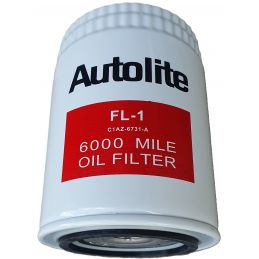
Motorcraft FL-1A
-------------------------------------------------------------------------------------------------------------------------------
Automatic transmission oil C4 and C6
Ford ATF Type F
Gearbox |
type |
Filling quantity (incl. converter) |
oil pan only (without converter) |
| C4 | 3-speed automatic | approx. 7.5 - 8.0 liters | approx. 3.8 - 4.5 liters |
| C6 | 3-speed automatic | approx. 10.0 - 11.0 liters | approx. 4.5 - 5.5 liters |
Attention:
Measure the fluid level in the automatic transmission with the engine running and warm in position P
-------------------------------------------------------------------------------------------------------------------------------
Manual transmission gear oil T10, Toploader, T5
Gearbox |
type |
Filling quantity |
Oil recommendation |
| Toploader | 3/4 gear cast | approx. 1.9 liters | SAE 80W-90 GL-4 |
| Borg Warner T-10 | 4-speed aluminum or cast iron | approx. 1.8 - 2.0 liters | SAE 80W-90 GL-4 |
| TREMEC / Borg Warner T5 | 5-speed aluminum | approx. 2.5 liters | DEXRON III automatic transmission fluid |
Check the fill level:
The gearbox is "full" when the oil reaches the bottom edge of the filler opening (feelable with your finger)
-------------------------------------------------------------------------------------------------------------------------------
Power steering original Ford
Ford ATF Type F approx. 2L
-------------------------------------------------------------------------------------------------------------------------------
Borgeson power steering
DEXRON III approx. 2L
-------------------------------------------------------------------------------------------------------------------------------
Steering gear Ford
Liqui Moly LM47 approx. 100-200g
-------------------------------------------------------------------------------------------------------------------------------
Rear axle 7.25" 8" and 9"
80W90 GL5 Hypoid oil mineral
additive for differential lock Ford XL-3 (120ml) is required for multi-disk locks, Trac Loc and Equa Loc
7.25" drop-out approx. 1.4 – 1.7 liters (installed on 6-cylinder engines, bolt pattern with 4 bolts, on V8s it is 5 bolts)
8" Small Case approx. 1.9–2.0 liters (mostly installed on the 289 and 302, sometimes on the 351)
9" Large Case approx. 2.3–2.5 liters (often installed on the 351, always on the 390 and 428)
Easy to distinguish between 8" and 9" differentials. With the 9" differential, you need a box wrench to open the two lower screws.
With the 8" you can reach all screws all around with an extension and socket.
Check the fill level:
The gearbox is "full" when the oil reaches the bottom edge of the filler opening (feelable with your finger)
-------------------------------------------------------------------------------------------------------------------------------
Cooling water
Recommended coolant when using a brass / copper cooler
Type IAT (Inorganic Additive Technology) / contains silicate / blue-green
Glysantin G48
BASF Classic Protect,
Prestone Classic
Ford VC-4-B
Total Coolelf Auto Supra
Mobil Antifreeze Extra
Ravenol HJC (blue-green, silicate-containing)
Standard VW TL 774-C (G11)
Coolant when using an aluminum radiator
Type HOAT / silicate-free / pink-red
Glysantin G40Prestone All Vehicles (yellow-green, HOAT-Universal)
MOTUL Inugel G+
Mannol Antifreeze AG13+ (pink)
Ravenol OTC (pink)
Shell Coolant OAT Ultra (G12++ compatible)
Standard VW TL 774-G (G12++)
Mixing ratio:
50/50 with distilled water is standard (down to –37 °C)
Motor |
Years of construction |
Coolant capacity (approx.) |
| 170 cu in I6 | 1964 - 1966 | approx. 7.5 liters |
| 200 cu in I6 | 1965 - 1973 | approx. 7.5 - 8.5 liters |
| 260 V8 | 1964 - 1965 | approx. 9.0 liters |
| 289 V8 | 1965 - 1968 | approx. 9.0 - 10.0 liters |
| 302 V8 | 1968 - 1973 | approx. 9.5 - 10.5 liters |
| 351W / 351C V8 | 1969 - 1973 | approx. 10.0 - 11.0 liters |
| 390 FE V8 | 1967 - 1969 | approx. 11.0 - 12.0 liters |
| 428 CJ / SCJ | 1968 - 1970 | approx. 12.0 - 13.0 liters |
Attention:
The exact values vary depending on the radiator size, hoses, with/without heating circuit, thermostat, etc.
Tip for filling:
- Fill the radiator up to 1" (2.5cm) below the filler opening,
do not fit the radiator cap yet.
- Warm up the engine
- As soon as the thermostat opens, refill coolant, again up to 1" below the
rim, refit the radiator cap
- Let the engine cool down and check the level
- Fill level is always 1" below the upper edge - the upper part of the
radiator serves as an "expansion tank"
-------------------------------------------------------------------------------------------------------------------------------
thermostat
-180F -82°C
- 195F- 90°C
Please do not use a thermostat between 160°F and 71°C. This will cause the engine to run too cool, resulting in increased wear and tear, higher fuel consumption, and oil sludge buildup.
-------------------------------------------------------------------------------------------------------------------------------
Radiator cap
13 lbs
-------------------------------------------------------------------------------------------------------------------------------
brake fluid
DOT3 (approx. 1L)
-------------------------------------------------------------------------------------------------------------------------------
ignition
- with an electronic ignition such as Pertronix Ignitor 10-12° advance ignition at
idle with the vacuum unit disconnected
- if a contact breaker is installed 8-10° advance ignition
- maximum deflection of the mechanical centrifugal force adjustment 34-36° at 3000
rpm
- maximum deflection centrifugal force + vacuum approx. 50°
-------------------------------------------------------------------------------------------------------------------------------
Wheel alignment
Camber / Toe / Caster
On the 1965 and 1966 Mustang, camber and caster are adjusted using shims.
These are adjustment plates that are placed under the upper wishbone.
From 1967 onwards, the caster adjustment was carried out via an adjustment thread at the front of the tension strut.
The camber is adjusted via an eccentric on the lower wishbone.
Camber and caster are always adjusted first, followed by toe.
The values in the original workshop manual are for old bias-ply tires.
The following settings are more suitable for modern radial tires (with and without Shelby drop):
Normal driving:
Total toe-in: 3mm (measured at the tire profile)
Corresponds to approximately 20 arc minutes on a 14" or 15" rim at the rim flange. Camber:
0 degrees . Caster
: +2.5 degrees.
Sporty driving:
Total toe-in: 2mm (measured at the tire profile)
Corresponds to approximately 12 arc minutes on a 14" or 15" rim at the rim flange .
Camber: -0.5 degrees.
Caster: +5 degrees.
All information is provided without guarantee. We assume no liability for the accuracy of the above information!